Insight
The Next Chapter of Digital Clinical Development: What we Heard from Industry Leaders
25 August, 2026
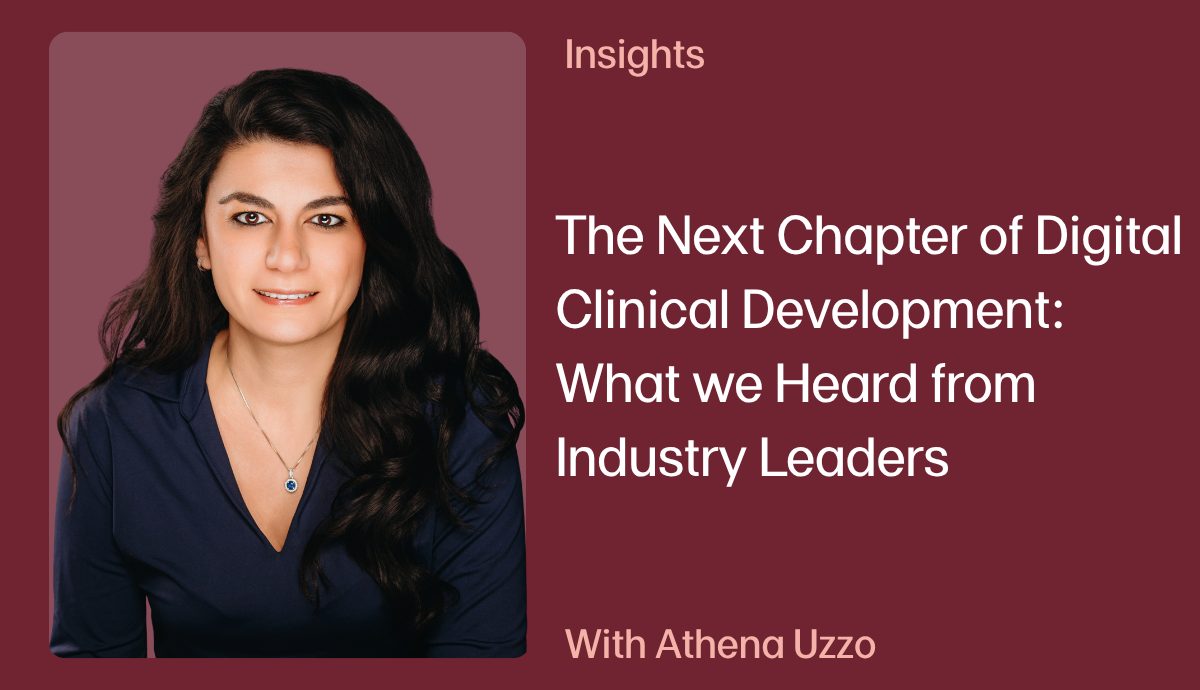
The Next Chapter of Digital Clinical Development: What We Heard from Industry Leaders
Recently, Faro brought together leaders from Biogen, Bristol Myers Squibb, Insmed, Merck, Pfizer and others for a conversation about the future of digital clinical development.
As I looked around the room, what struck me was the range of perspectives represented. We had leaders from Clinical Development, Medical Writing, Data Standards, AI Strategy, Clinical IT and Digital Transformation. Each came to the conversation from a different vantage point and from organizations at different stages of their digital journey.
Having spent much of my career working with clinical development organizations through different stages of technology adoption, I was particularly interested in where we would see alignment, and where perspectives would differ. What stood out as the discussion unfolded was how much consistency there actually was in what we heard.
For years, our industry has been investing in structured data, AI, digital protocols, industry standards and new ways of working. Across the organizations in the room, there was a shared sense that these pieces are starting to come together. The conversation is moving beyond “Can we do this?” to “How do we scale it?”
Three themes stood out to me:
The Digital SoA is becoming a foundation for connected, AI-enabled clinical development
The Digital Schedule of Activities was a consistent thread throughout the discussion.
Today, a Digital SoA creates the opportunity for structured, reusable study information to support better protocol design, optimization, and automation. But the discussion reflected a much bigger opportunity as more of the study is represented digitally, and as agentic AI matures enough to reason and act on that structure rather than simply reference or extract from it.
Upstream, the conversation focused on bringing research, evidence and clinical development planning into the digital journey earlier, helping clinical scientists make better-informed design decisions before formal study design begins.
Downstream, the opportunity looks different. Once the SoA and surrounding protocol elements exist as structured data rather than narrative text, they become something AI agents can act on directly. Instead of a human manually re-keying visit schedules into an EDC build, or reconciling a budget grid against a protocol that has been amendment, an agent can read the structured SoA and propose the downstream artifact for review. That shifts the work from recreating information to validating and approving it, which is a meaningfully different job for the teams involved.
Participants pointed to several areas where this kind of agentic execution is becoming realistic:
- EDC build, where structured visit and procedure data can seed form and edit-check specifications instead of requiring manual translation from protocol text
- External data transfer, where agents can map SoA elements to vendor specifications and flag inconsistencies before they become data queries
- Budgeting and vendor management, where structured procedure counts and visit schedules can drive cost estimates and vendor scopes that stay synchronized with the protocol as it evolves
- Statistical analysis planning, where endpoints and assessments defined upstream can populate SAP shells with traceable linkage back to protocol intent
- Reporting and site execution, where structured data can support real-time visibility into site burden and protocol adherence rather than retrospective reconciliation
The consistent theme was that none of this replaces human judgment. It changes where human effort is spent, from manual translation and reconciliation toward oversight, exception handling, and decisions that require clinical or operational context an agent doesn't have.
The vision that emerged was bigger than the Digital SoA itself: a more connected clinical development process where structured information, and the agents that act on it, move with the study across its lifecycle.
Agentic AI needs structured information and connected workflows
Agentic AI was naturally a significant part of the conversation. Across the group there was already broad experimentation with AI systems and tools across a wide range of use cases, but the discussion was less about where agentic AI could be applied and more about where it can deliver measurable value.
When study information, business logic and clinical context are represented in a way that can be reliably understood and reused, agentic AI has the potential to do much more than generate text. It can help automate work across connected workflows while preserving the underlying intent of the study.
Protocol authoring provided a great example use case. Organizations have invested significantly in both internal and external authoring solutions, both structured-content- and AI-based, yet there was clear agreement that the end-to-end authoring experience still remains largely unsolved.
The opportunity isn't simply to generate protocol text faster. It's to improve the broader authoring workflow, from translating design decisions into content through managing changes and revisions, reconciliation and downstream reuse.
Scaling is as much an organizational challenge as a technology challenge
Some of the strongest alignment of the day was around what it takes to actually make these changes stick.
Participants were consistent that without governance and clear ownership, structured data becomes another artifact to maintain rather than the system of record. The organizations furthest along had provided clarity to their organizations about which one wins when the digital protocol and the document disagree. Without that answer, teams often default back to the document as the "real" version under deadline pressure, and the structured data risks falling out of use.
Scaling also depends on a clear line to value. New technology alone doesn’t change how an organization works, and rarely is technology transformation worth the organizational effort on its own. It has to translate into outcomes teams can point to: faster study start-up, improved feasibility, less burden on sites and patients, fewer avoidable amendments and less downstream rework.
And the learning shouldn't end when a study does. Participants emphasized the opportunity to use outcomes from completed studies to inform future protocol design, creating a continuous learning loop rather than starting from a blank page each time.
Where we go from here
We designed the roundtable to be a conversation, not a presentation. We wanted attendees to compare experiences, challenge assumptions, and learn from one another.
The discussion also helped sharpen our thinking about where we go next at Faro, including expanding the Digital SoA, rethinking protocol authoring, connecting structured protocol information to more downstream workflows, and building AI and automation on top of that foundation.
One of my favorite things about conversations like this is seeing industry leaders come together not simply to adopt new technology, but to help define what the next generation of clinical development should look like.
There is still a tremendous amount for the industry to solve. But after spending a day with this group, I came away convinced that there is meaningful alignment on the direction we need to go.
The future isn't a collection of better individual tools. It's a more connected clinical development ecosystem, built on structured information that can move with the study, support better decisions and enable increasingly intelligent automation through agentic workflows.
We're looking forward to continuing the conversation.
Athena Uzzo is SVP, Customer at Faro, where she leads the company’s Customer Strategy and Implementation, and Product Experience organizations. She has spent more than 20 years working across clinical research, technology and customer organizations, helping life sciences companies adopt and scale new ways of working.
Related updates & insights